Ten Years, Three Tribes
Of fifty-five Intertribal Timber Council member tribes, three made it through

The Tulalip Tribes have been a fishing people for as long as anyone remembers. Their reservation runs 22,000 acres along the eastern shore of Puget Sound, 35 miles north of Seattle. The waters at the edge of the reservation, where the tide goes out and exposes the mudflats, are where shellfish grow, and salmon come to spawn. In an 1855 treaty, the United States agreed that those waters would always belong to the Tribes. The treaty remains in force today.
Today, 73 private docks and 124 private mooring buoys cover the Tulalip shoreline. Many were built without tribal permission. Tulalip’s own Natural Resources Department documents the consequences: water quality has fallen, salmon populations have fallen, and shellfish beds have closed.
In 2019, Tulalip asked the federal government for the authority to manage their own shoreline. The federal government said no.
In 2023, they asked again. The federal government said no.
What the Statute Says
The vehicle Tulalip was trying to use is the Indian Trust Asset Reform Act of 2016 (ITARA), which established a 10-year demonstration project, a trial program meant to test whether tribes could manage their own trust assets.
Trust assets are tribal property held by the federal government on behalf of the tribe. Most tribal land, water, mineral, and forest resources fall in this category. Under federal law, most decisions about trust assets require federal approval. ITARA was passed to change that for tribes that wanted more direct authority over their own resources.
A tribe applies to participate in the demonstration project. It then drafts an Indian Trust Asset Management Plan listing the trust assets it wants to manage. Once the plan is approved, the tribe manages those assets without a case-by-case federal sign-off.1
The statute does not define what counts as a “trust asset.” The first required element of any management plan is to “identify the trust assets” that the plan will manage.2 The statute leaves the identification to the tribe.
The Department of the Interior reads the same statutory phrase, “identify the trust assets,” differently. Beginning in 2018 and remaining in effect today, the Department has told tribes that the demonstration project covers only forestry resources and surface leases, and nothing else.
That reading is the reason Tulalip was told no. Tidelands, fisheries, shellfish beds, water rights, and other trust assets that tribes hold under treaty or federal statute are not, in the Department’s view, what the program covers.
The program expires June 22, 2026, ten years to the day after it became law. The expiration matters because the statute itself, as Congress wrote it, allowed broader use than the Department has permitted. If the program ends, the broader authority Congress passed ends with it. Whatever interpretation the Department has settled on becomes final.
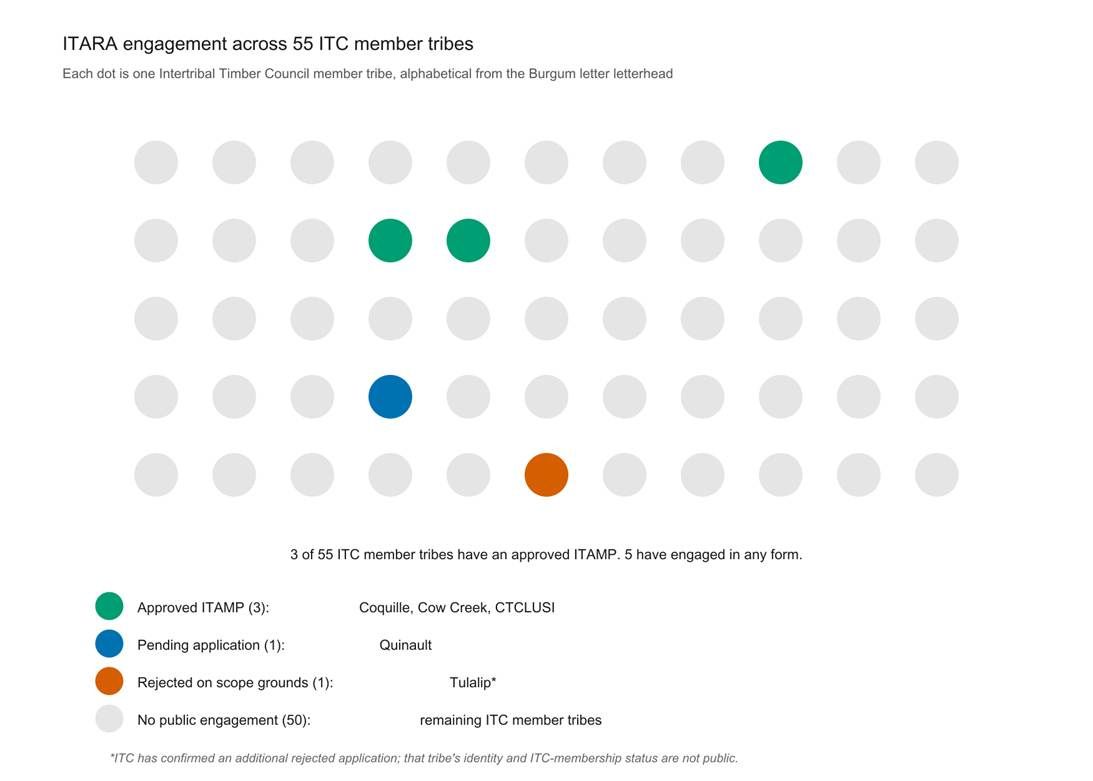
Three tribes have approved plans. Two more have publicly engaged, one with a pending application and one (Tulalip) rejected on scope grounds. Fifty of the fifty-five member tribes of the Intertribal Timber Council have no public record of engagement with the program.3
The Path to Approval
Approval was not automatic, even for tribes whose requests fit the Department’s narrow scope. The process took years.
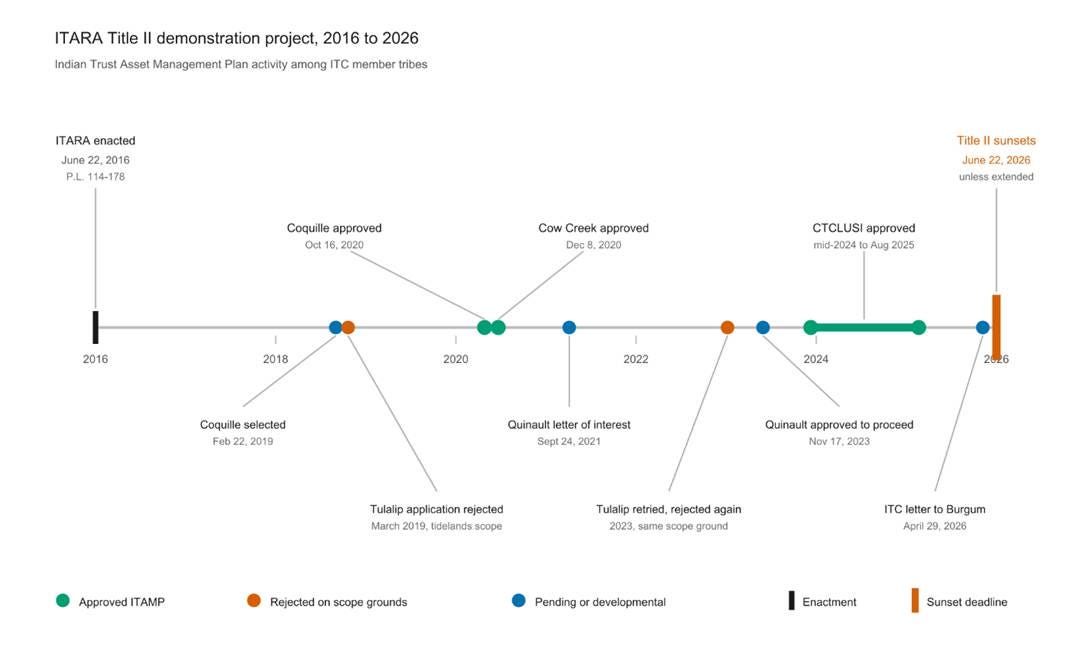
ITARA was signed into law in June 2016. For more than a year, the Department did not act on the demonstration project. The Intertribal Timber Council wrote to the Secretary in October 2017, requesting action, and a formal consultation process continued for another year. The Demonstration Project was formally established in October 2018.4
A tribe seeking to participate had to complete several steps in sequence: apply for selection, develop a forest management plan, draft an Indian Trust Asset Management Plan, and develop tribal regulations governing asset management. Each step required a separate sign-off from the Department.
The Coquille Indian Tribe of Oregon was the first to complete this process. It was selected in February 2019. It submitted its plan in June 2020. The plan was approved in October 2020.5 Four years and four months had passed since ITARA became law. Part of this gap reflects Department processing time. Part reflects the cost to tribes of preparing applications and developing management plans without dedicated federal funding for the work. The cumulative effect, however, is that the demonstration project did not produce its first approved plan until more than four years after enactment.
Guy Capoeman, President of the Quinault Indian Nation, has written directly about why the early years took so long. The Bureau of Indian Affairs, the agency within the Department that handles tribal programs, “showed little interest in implementing ITARA” until tribes pushed for action. Many of the responsible federal staff, Capoeman wrote, “failed to embrace, and some even resisted” the program.6
Who Got In
The Intertribal Timber Council represents tribes with active forestry programs and trust forested lands. The Council has advocated for ITARA at multiple Congressional hearings and in formal correspondence with the Department of the Interior, including its April 29, 2026, letter to Secretary Burgum.7
In the ten years since ITARA became law, three of the Council’s fifty-five member tribes have completed an Indian Trust Asset Management Plan (ITAMP): the Coquille Indian Tribe of Oregon in October 2020, the Cow Creek Band of Umpqua Tribe of Indians in December 2020, and the Confederated Tribes of Coos, Lower Umpqua, and Siuslaw Indians between mid-2024 and August 2025.8 The Quinault Indian Nation sent a letter of interest in 2021. The Department took more than two years to respond. Approval to proceed arrived in 2023, and Quinault is still working through the multi-step approval cascade.9 The Tulalip Tribes were told that the trust asset they identified did not qualify. The remaining fifty tribes have no public record of engagement with the program.
The structural argument here is not that all fifty have tried and been denied. ITC’s data suggest that many of the fifty may have existing forestry management arrangements through other federal authorities, reducing their incremental need for ITARA. The argument is about the five that did engage: only three were approved, one is waiting, and at least one (Tulalip) was rejected because the Department interpreted “trust asset” narrowly enough to exclude the very resources the tribe holds under treaty.
Tribes considering ITARA faced a structural disincentive that compounded the scope problem. The Department took four years to launch the demonstration project. By the time the first plans were approved in 2020, only six years remained before the program’s June 22, 2026, sunset. A tribe deciding whether to build the institutional infrastructure ITARA requires was being asked to invest in authority that might not exist past 2026, with no public commitment from Congress or the Department that reauthorization would come.
The first two plans were approved within two months of each other. The third arrived nearly four years later.
For comparison, consider Tribal Self-Governance Compacts under Title IV of the Indian Self-Determination and Education Assistance Act (ISDEAA). These compacts let tribes administer Department of the Interior programs directly. More than 300 federally recognized tribes participate in self-governance under Title IV, covering hundreds of millions of dollars in federal program funding annually.10
ITARA rests on the same statutory tradition of tribal self-determination as Title IV. But where Title IV produced widespread engagement, ITARA produced three approved plans. The contrast is not about tribal interest. It is about whether the implementing agency’s reading of the law leaves anything for tribes to use.
The Structural Pattern
The Department’s narrow reading is the immediate cause of the bottleneck. The broader pattern is one I have written about before. Congress passes a statute authorizing tribes to manage something themselves. The implementing agency interprets the authority narrowly, underfunds the transition, or simply does not act. Few tribes use the authority Congress passed.
The pattern is general. Earlier this month, Southern Ute became the first tribe in twenty-one years to secure federal approval of a Tribal Energy Resource Agreement (TERA), a 2005 statute that allows qualified tribes to manage energy leases on tribal land without case-by-case Secretarial approval. Energy leasing covers oil and gas, coal, uranium, wind, solar, geothermal, and biomass projects on tribal trust lands. One tribe in twenty-one years.11
In March, I wrote about the HEARTH Act, which lets tribes manage surface leases on their trust lands without case-by-case federal approval.12 The statute did not appropriate funds for the administrative work tribes need to take advantage of the authority. Most tribes have not used it.
ITARA fits this pattern with a particular variant. The statute does not narrow the types of trust assets a tribe can bring into a plan. The Department of the Interior did, beginning in 2018. The statute leaves the identification to the tribe. The Department decides which identifications to accept.
Congress wrote an open authority. The Department closed it.
Who Is In, Who Is Out
The Department’s narrow reading sorts tribes by the type of asset they want to manage. Tribes whose trust assets are forestry resources or surface leases are inside the program. Tribes whose trust assets are anything else are outside.
For tribes inside the scope, ITARA extends the authority that tribes already exercise over their forests, but with a meaningful upgrade: management decisions move from a multi-step federal approval cascade to direct tribal authority. The 2023 Indian Forest Management Assessment Team (IFMAT) report found that approximately 80 percent of tribal forested trust lands are already managed by tribes themselves under self-determination contracts (Title I of P.L. 93-638), cooperative agreements, or self-governance compacts.13 ITARA removes the case-by-case BIA sign-off that those arrangements still require.
For tribes outside the scope, the question of capacity does not arise. The exclusion is not based on what tribes can do but on the Department’s view of which assets qualify. The Tulalip Tribes’ tidelands are the named case. The Intertribal Timber Council has confirmed at least one additional rejection on the same grounds. The tribe’s identity is not disclosed because ITC protects member confidentiality unless tribes themselves authorize disclosure.14
What Congress and the Secretary Can Do
H.R. 5515, the pending bipartisan bill from Representative Hurd of Colorado and Representative Randall of Washington, would do two things. First, it would make the demonstration project permanent, ending the sunset on June 22, 2026. Second, and more importantly, it would add a statutory definition of “trust asset” that explicitly includes “trust lands, natural resources, trust funds, or other assets held by the Federal Government in trust for Indian tribes.”15 This addresses the scope problem: with that definition in statute, the Department could no longer narrow the program to forestry and surface leases alone. The Department of the Interior submitted a Statement for the Record to the House Subcommittee on Indian and Insular Affairs in November 2025, supporting the bill’s intent.16 The Intertribal Timber Council submitted its own letter of support, naming in the public record that tribes have been denied participation for trust resources outside forests and surface leases.¹⁷
There is also an administrative path. Section 203(d)(2) of the existing statute authorizes the Secretary of the Interior to extend the demonstration project. The Intertribal Timber Council wrote to Secretary Burgum on April 29, 2026, requesting that he exercise this authority.17 Extension by itself does not change the scope; it preserves the program long enough for the scope question to be answered, whether by H.R. 5515 or by the Department changing its own interpretation. For tribes currently operating under approved plans, including Cow Creek, the alternative to extension is disruption: ongoing management activities authorized under ITARA would face an uncertain legal foundation.
A statute amendment is more durable and addresses both the sunset and the scope. An administrative extension can be granted by a single Cabinet decision and addresses the sunset alone. Both paths face the June 22, 2026, deadline.
The Cut
In 2016, Congress passed a law that let a tribe identify which of its trust assets it wanted to manage. The statute did not define “trust asset” or list which assets could be included. In 2018, the Department of the Interior decided that the term covered forestry resources and surface leases. Five years later, after a change of administration, the Department made the same decision. On June 22, 2026, the program expires.
Tulalip asked to bring its tidelands inside an Indian Trust Asset Management Plan. The Department said no. At least one other tribe was told the same. The tribes whose trust assets are not forestry or surface leases will not have a chance to ask before June 22, unless either H.R. 5515 becomes law or the Secretary acts under Section 203(d)(2).
Tribes whose trust assets the Department reads to qualify can use what Congress passed. Tribes whose trust assets the Department reads not to qualify cannot. That is the cut.
Indian Trust Asset Reform Act, 25 U.S.C. § 5601 et seq. The demonstration project itself is in Title II.
25 U.S.C. § 5613(a)(2)(A) (requiring a proposed Indian trust asset management plan to include provisions that “identify the trust assets that will be subject to the plan”).
See the methodology note at the end of this post for the engagement rate and audit table.
Guy Capoeman, President of the Quinault Indian Nation, written response to questions for the record following the February 25, 2025, hearing of the House Subcommittee on Indian and Insular Affairs, “Federal Indian Trust Asset Management: Progress Made But Improvement Needed.” The Demonstration Project was formally established on October 1, 2018, by Assistant Secretary of Indian Affairs Tara Sweeney.
Coquille’s selection date (February 22, 2019), ITAMP submission date (June 9, 2020), and approval date (October 16, 2020) are documented in the Department of the Interior and Bureau of Indian Affairs press release announcing approval of Coquille’s ITAMP (October 20, 2020). Cody DeSautel’s February 25, 2025, testimony to the House Subcommittee on Indian and Insular Affairs corroborates that Coquille had the first approved ITAMP and that the Department did not sign the first ITAMP until October 2020, but does not state the precise February 22, 2019, selection date or the June 9, 2020, submission date.
Capoeman QFR response, February 25, 2025.
Letter from Cody Desautel, President of the Intertribal Timber Council, to Secretary of the Interior Douglas Burgum, “Formal Request for Secretarial Extension of the ITARA Demonstration Project Authority,” April 29, 2026. The letter is not publicly available; shared with the author by the Intertribal Timber Council in May 2026.
Three approved ITAMPs: Coquille Indian Tribe (October 2020), Cow Creek Band of Umpqua Tribe of Indians (December 2020), and Confederated Tribes of Coos, Lower Umpqua and Siuslaw Indians (approval date between mid-2024 and August 2025; the precise date is not in the public record reviewed for this post). The figure of three approved plans is documented in Cody DeSautel’s February 25, 2025, written testimony and in correspondence with the Intertribal Timber Council (May 2026). Tim Vredenburg’s November 19, 2025, testimony to the House Natural Resources Committee confirms Cow Creek’s status as one of the three. The H.R. 5515 press release from Representative Hurd’s office references the demonstration project’s progress without naming all three tribes individually.
Guy Capoeman, President of the Quinault Indian Nation, written testimony before the House Subcommittee on Indian and Insular Affairs, “Federal Indian Trust Asset Management: Progress Made But Improvement Needed,” February 25, 2025. Quinault’s letter of interest was submitted on September 24, 2021, to then Assistant Secretary of Indian Affairs Bryan Newland. Approval to proceed with developing an ITAMP came in a letter from Assistant Secretary Newland dated November 17, 2023. Capoeman’s testimony states that Quinault has since been working to develop its ITAMP, contracting with entities to assist in preparing the plan.
Self-Governance Compacts at the Department of the Interior are authorized under Title IV of the Indian Self-Determination and Education Assistance Act, as added by the Tribal Self-Governance Act of 1994, Pub. L. No. 103-413, and codified principally at 25 U.S.C. §§ 5361-5377. The Department of the Interior’s FY 2025 Bureau of Indian Affairs budget justification estimated that in FY 2024, the Office of Self-Governance would distribute approximately $700 million to 306 tribes covered by 138 self-governance compacts.
U.S. Department of the Interior, “Interior Enters into Nation’s First-Ever Tribal Energy Agreement,” press release, May 12, 2026, https://www.doi.gov/pressreleases/interior-enters-nations-first-ever-tribal-energy-agreement. See also “Southern Ute gains expanded energy authority under first-ever TERA agreement,” Tribal Business News (May 17, 2026), https://tribalbusinessnews.com/sections/energy/15616-southern-ute-gains-expanded-energy-authority-under-first-ever-tera-agreement. The Tribal Energy Resource Agreement authority was created under Title V of the Energy Policy Act of 2005, Public Law 109-58, codified at 25 U.S.C. § 3501 et seq., and amended by the Indian Tribal Energy Development and Self-Determination Act Amendments of 2017, Public Law 115-325.
See Stratmann, “Congress Keeps Giving Tribes Powers They Can’t Afford to Use,” Rules & Results (March 2026), for the HEARTH adoption analysis. As of 2025, 88 of 329 lower-48 reservations had adopted HEARTH regulations, an adoption rate of approximately 27 percent.
Cody Desautel, President of the Intertribal Timber Council, written testimony before the House Subcommittee on Indian and Insular Affairs, “Federal Indian Trust Asset Management: Progress Made But Improvement Needed,” February 25, 2025. The testimony cites the 2023 Indian Forest Management Assessment Team (IFMAT) report for the 80 percent figure. Self-determination contracts referenced in the body are Title I contracts under the Indian Self-Determination and Education Assistance Act (P.L. 93-638, enacted 1975). The referenced self-governance compacts are Title IV of the same act, added by P.L. 103-413 (the Tribal Self-Governance Act of 1994).
Confirmed in correspondence with the Intertribal Timber Council, May 2026. The tribe’s identity is not public.
H.R. 5515, 119th Congress (introduced September 19, 2025, by Rep. Jeff Hurd of Colorado and Rep. Emily Randall of Washington). The bill amends Section 205 of ITARA (25 U.S.C. § 5614) to add a definition of “trust assets” that includes “trust lands, natural resources, trust funds, or other assets held by the Federal Government in trust for Indian tribes and individual Indians” and any resource that “is, or has previously been, included in an integrated resources management plan or other management plan approved by the Secretary.”
Bureau of Indian Affairs, U.S. Department of the Interior, Statement for the Record submitted to the House Subcommittee on Indian and Insular Affairs legislative hearing on H.R. 4276, H.R. 5515, H.R. 5682, and H.R. 5696, November 19, 2025. The Department wrote: “The Department supports the intent of H.R. 5515.”
Letter from Cody DeSautel, President, Intertribal Timber Council, to Chairman Bruce Westerman and Ranking Member Jared Huffman, House Committee on Natural Resources (November 18, 2025) (supporting H.R. 5515, the Indian Trust Asset Reform Amendment Act). Available in the House Committee on Natural Resources repository of hearing materials for the November 19, 2025, legislative hearing.
Methodology
The denominator of 55 tribes is the membership of the Intertribal Timber Council, as listed on ITC’s April 29, 2026, letter to the Secretary of the Interior. As the body describes, the Council has advocated for ITARA at multiple Congressional hearings, and its member tribes operate tribal forestry programs. The denominator is conservative in two directions.
First, tribes outside ITC are not included. Examples include tribes in Southern California and along the Atlantic coast whose primary trust assets are not forestry. A broader denominator that included these tribes would produce a lower adoption rate.
Second, some tribes within the 55 may already have functional forestry management arrangements through Title I contracts under P.L. 93-638 (commonly called 638 contracts), Title IV self-governance compacts, or cooperative agreements, thereby reducing their incremental need for ITARA. Their lack of engagement with ITARA may reflect overlapping existing authority rather than a barrier to adoption. The structural argument in this post applies most directly to tribes that tried to use ITARA for trust assets outside their existing arrangements, such as Tulalip’s tidelands and at least one other tribe’s rejected application.
A more comprehensive count of tribes whose trust assets the broader statutory reading could reach, combining BIA forestry records, trust land geographic data, and tribal treaty rights, would produce a larger universe and a correspondingly lower adoption rate. That analysis is beyond the scope of this post, but it is a worthwhile question for future research.
The numerator counts publicly verifiable engagement with the ITARA demonstration project: approved ITAMPs (three: Coquille, Cow Creek, and Confederated Tribes of Coos, Lower Umpqua, and Siuslaw Indians), tribes approved to proceed but still developing their plan (one: Quinault), and publicly documented rejections on scope grounds (one: Tulalip). The Intertribal Timber Council has confirmed an additional rejected application; that tribe’s identity and ITC-membership status are not public.
A cell-by-cell audit table coding each of the 55 ITC member tribes is available on request from the author at tstratma@gmu.edu.